Prescription and treatment
Dry weight and target weight
Target weight is a changing clinical estimate that balances excess volume against symptoms of low volume.
The key idea
Dry weight is an estimate of weight at an acceptable fluid balance. Target weight is the prescribed end-of-session goal and may differ temporarily. There is no single definitive test: symptoms, examination, blood pressure and weight trends are considered together. KDIGO · 2020 · blood pressure and volume management.
| Term | What it describes | Unit or assessment |
|---|---|---|
| Estimated dry weight | Estimate of an acceptable fluid balance | Repeated clinical assessment |
| Target weight | Prescribed end-of-session goal | kg; may change with the situation |
| Interdialytic gain | Difference from the previous post-dialysis weight | kg; not automatically all excess fluid |
| Additional tools | For example lung ultrasound or bioimpedance | Support, rather than replace, assessment |
A starting weight of 72 kg and a target of 70 kg differ by 2 kg. This is not automatically a final prescription to remove 2 L: fluids given during treatment, residual urine, tissue-weight changes and tolerance also need consideration.
The DRIP trial supported gradual dry-weight reduction for blood-pressure control in selected hypertensive patients, with an increase in some intradialytic hypotensive symptoms. It does not establish that pursuing the lowest possible weight suits everyone. Agarwal et al. · DRIP · randomized trial · 2009.
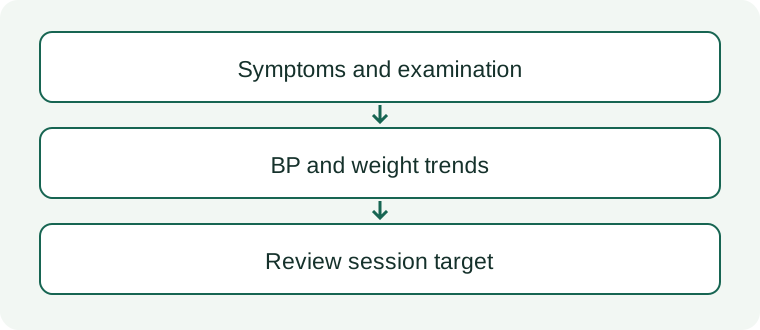
In haemodialysis, the dry or target weight is used as a clinical target for estimating excess fluid. It is the post-dialysis weight at which the patient is thought to have an acceptable fluid balance, without clinically important oedema or excess water in the tissues or blood vessels.
Clinically, it has traditionally been described as the lowest weight a patient can tolerate without developing symptoms during dialysis or an excessive fall in blood pressure. That definition is useful but incomplete. Symptoms during dialysis are also affected by the distribution of water in the body, the balance between the ultrafiltration rate and plasma refill from the interstitial space, lean body mass, nutritional status, medication, autonomic function, and cardiac disease.
Target weight is therefore usually estimated iteratively rather than calculated once. The team reviews intradialytic hypotension, signs of volume overload, blood-pressure patterns, symptoms, and the patient’s weight trend, and then adjusts the target gradually when appropriate.
Clinical assessment
Assessing dry weight is difficult because body weight includes both fluid and solid tissue, symptoms during dialysis can have several causes, and genuine gain or loss of muscle and fat can be mistaken for a change in fluid status.
Clinical assessment may include jugular venous pressure, peripheral oedema, lung findings, breathlessness, blood-pressure patterns, and the appearance and behaviour of the vascular access.
Weight gain may reflect improved nutrition and increased muscle mass, but it may also reflect volume overload. Conversely, if a malnourished patient loses tissue while the recorded target weight remains unchanged, excess fluid can be hidden. Accurate weighing on the same regularly calibrated scale is therefore essential.
Intradialytic hypotension may occur because the target weight has been set too low, because fluid is being removed faster than the circulation can be refilled from the tissues, or because of cardiac disease, autonomic dysfunction, meals, temperature, or medication. It does not prove by itself that the patient has reached a correct dry weight.
Assessment is especially difficult early in a dialysis course, when salt and water excess may coexist with little visible oedema and nutritional status may be changing. Improvement in nutrition can make a previously reasonable target weight too low.
Persistently underestimating volume overload can contribute to hypertension and left-ventricular hypertrophy and is associated with greater cardiovascular risk. At the same time, forcing the weight too low can cause recurrent hypotension, cramps, organ hypoperfusion, fatigue, and loss of residual kidney function. The aim is a safe balance, not the lowest possible number on the scale.
A large proportion of hypertension in people receiving haemodialysis is related to chronic excess volume, but the contribution varies between patients and blood pressure has many additional causes. Reaching a target weight during one session does not by itself prove that the target is correct.
Historical observational experience from the Tassin dialysis centre in France—where long, slow eight-hour sessions were used three times weekly—reported low use of antihypertensive medication and favourable long-term outcomes. These observations support the physiological value of slower, longer fluid removal, but they were not randomized comparisons and should not be interpreted as proof that one schedule is best for every patient. More frequent dialysis can also improve volume control in selected people.
There is no single gold-standard test for dry weight. Clinical examination and trends remain central, while tools such as lung ultrasound, bioimpedance, natriuretic peptides, and relative blood-volume monitoring may provide additional information in selected settings. None should be used in isolation.
Key points
- There is no single gold-standard test; teams combine symptoms, examination, blood pressure, weight trends, and other tools when needed.
- Oedema, venous congestion, and breathlessness may suggest excess volume but are not specific on their own.
- Low blood pressure during treatment has several possible causes and does not automatically mean the target weight is too low.
- Trends over time and small, stepwise adjustments are more useful than chasing one number.
Frequently asked questions
Is there one accurate dry-weight test?
There is no single gold standard. Weight and blood-pressure trends, symptoms and examination are combined, with additional tools when needed.
Are dry weight and target weight identical?
They are related but distinct. During acute illness or poor tolerance, a temporary target may differ, while the risks of excess volume are reviewed.
Does low blood pressure prove target weight is too low?
That is one possible cause. Fluid-removal speed, cardiac function, medicines and other factors may contribute; a fuller assessment is needed.
Does every weight gain mean excess water?
No. Muscle, fat and nutritional changes also affect weight. Trends and nutritional status should be reviewed together.
Sources for this explanation
- KDIGO · 2020 · blood pressure and volume management
- UK Renal Association · Haemodialysis · July 2019
- Agarwal et al. · DRIP · randomized trial · 2009
Content and evidence checked: . The check covered UF, KoA or dry-weight interpretation, examples and evidence limits in this article. It is not independent clinical certification or a review of every article on this site.
Share the article link or reuse this original diagram with attribution and a link to the article. Source publications and their figures retain their own rights. Download the educational SVG