Prescription and treatment
Ultrafiltration
Removing excess water and how the treatment time, pressure, and individual removal rate are related.
The key idea
UF means ultrafiltration: water moving through the dialyser membrane. Net UF is the fluid removed from the patient. It differs from urea clearance and from the much larger convective volume used in HDF. Tolerance depends on treatment time, circulatory refill and the patient’s condition. KDIGO · 2020 · blood pressure and volume management.
| Term | What it describes | Unit or assessment |
|---|---|---|
| Net UF volume | Fluid to remove during the session | mL or L |
| UF rate | Volume divided by treatment time | mL/h; mL/kg/h when divided by weight |
| KUF | Dialyser water permeability under test conditions | mL/h/mmHg |
Arithmetic example only: 2000 mL removed over 4 hours gives 500 mL/h. Using a weight of 70 kg gives about 7.1 mL/kg/h. Specify which weight was used; the calculation does not establish a suitable prescription for that person.
Values such as 13 mL/kg/h are used as review signals in some frameworks. Observational risk associations do not establish a personal safety threshold, and being below a number does not guarantee safety. A 2023 cohort also illustrates the influence of body weight, age and other factors. Mermelstein et al. · CJASN 2023 · observational cohort.
Ultrafiltration (UF) is used to remove water during haemodialysis (HD). The movement of water through the membrane can also carry dissolved substances; that solute transport is called convection or solvent drag.
Removing a clinically meaningful amount of solute mainly by convection requires a large volume of filtration. In haemofiltration and haemodiafiltration, most of that filtered plasma water must be replaced with sterile, ultrapure substitution fluid so that the patient’s prescribed net fluid removal remains separate from the much larger convective volume.
Convective treatment can improve the removal of some larger middle molecules, such as beta-2 microglobulin, compared with predominantly diffusive conventional HD. Haemodiafiltration and high-flux membranes are commonly used when a larger convective component is intended. Haemodynamic tolerance depends on the full prescription and the patient; convection itself does not guarantee stability.
In conventional haemodialysis, UF is primarily used to remove the excess water accumulated between sessions—often several litres, although the amount varies widely. Water crosses the dialyser because of the transmembrane pressure (TMP). Older systems relied more directly on pressure-based control. Most modern machines use volumetric balancing: they continuously compare dialysate entering and leaving the dialyser and control the difference to deliver the prescribed net UF.
Methods used to control ultrafiltration during haemodialysis
The volume of filtrate can be controlled through pressure-based or volumetric systems in the extracorporeal and dialysate circuits.
Pressure-controlled ultrafiltration
In pressure-controlled systems, pressure in the blood compartment may range from positive to negative values depending on blood flow and circuit resistance. Pressure in the dialysate compartment can be lowered by restricting dialysate outflow when a pump is positioned on the outflow line. Very negative pressures can be generated, but excessive pressure can damage the dialyser; modern equipment therefore uses specified operating limits and alarms.
Pressures are usually measured at defined points in the blood and dialysate lines. The pressure inside the dialyser is not identical at every point, and some machines measure both inlet and outlet pressures to estimate the average gradient more accurately.
Using the dialyser’s ultrafiltration coefficient (KUF), the machine can estimate the TMP needed to obtain a requested UF rate. KUF is supplied by the manufacturer under test conditions and describes water permeability, commonly in mL/hour/mmHg.
Small errors in TMP measurement can produce large errors in fluid removal when UF is controlled only by pressure, especially with highly permeable membranes.
KUF is not perfectly constant during a treatment. Protein deposition, microscopic fibre clotting, changes in haematocrit, and concentration of blood within the dialyser can alter effective water permeability.
Volumetric control
Volumetric control is more precise and became particularly important with high-flux membranes. Balancing systems measure or tightly control the dialysate volume entering and leaving the dialyser, so net UF is determined directly by the difference rather than inferred only from pressure and a nominal KUF. The prescribed UF rate can then be distributed across the session, including with an approved UF profile when clinically indicated.
Nearly all modern haemodialysis machines use volumetric UF control. Even so, staff must confirm the prescription, treatment time, patient weight, circuit integrity, and clinical response. Patients should never change the fluid target, session length, pressure limits, or UF profile without the dialysis team.
Key points
- Symptoms become more likely when fluid removal exceeds the body’s ability to refill the circulation.
- Longer or more frequent treatment may allow a slower removal rate when needed.
- Dizziness, cramps, nausea, or low blood pressure call for review of the prescription and other factors.
- There is no single ultrafiltration limit that suits every patient in every situation.
Frequently asked questions
Is UF the same as cleaning the blood?
No. UF describes water removal; clearance describes removal of a particular solute. Water may carry solutes by convection, but fluid volume alone does not measure dialysis adequacy.
Is there one safe UF rate for everyone?
No single value suits every patient and treatment. The team considers symptoms, blood pressure, cardiac status, volume overload and treatment time.
Does a longer session lower the UF rate?
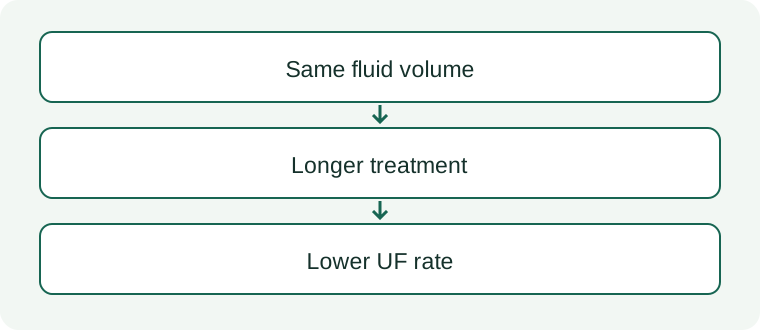
For the same fluid volume, a longer treatment lowers the calculated rate. Changes to time and prescription belong in a discussion with the dialysis team.
Why can dizziness occur while excess fluid remains?
Fluid can leave the circulation faster than it refills from tissues. Other causes are possible too; dizziness alone does not establish whether target weight is correct.
Sources for this explanation
- KDIGO · 2020 · blood pressure and volume management
- UK Renal Association · Haemodialysis · July 2019
- Assimon et al. · AJKD 2016 · observational cohort
- Mermelstein et al. · CJASN 2023 · observational cohort
Content and evidence checked: . The check covered UF, KoA or dry-weight interpretation, examples and evidence limits in this article. It is not independent clinical certification or a review of every article on this site.
Share the article link or reuse this original diagram with attribution and a link to the article. Source publications and their figures retain their own rights. Download the educational SVG