Prescription and treatment
Steroidal and nonsteroidal MR antagonists in CKD
A balanced comparison of spironolactone, eplerenone, finerenone and aldosterone synthase inhibitors.
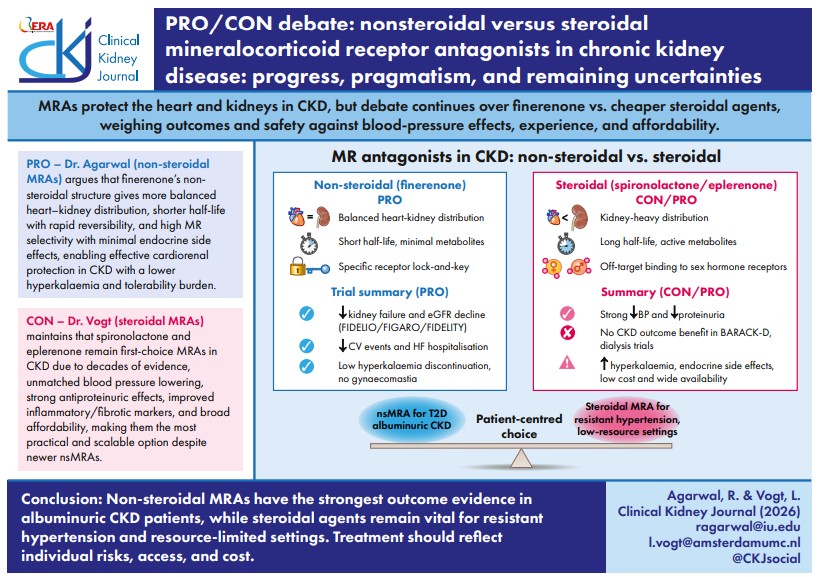
Opinion in favor of nonsteroidal mineralocorticoid receptor antagonists (Pro)
Spironolactone and eplerenone are flat steroid molecules that act as a partial cognate in recruiting transcriptional cofactor recruitment.
As for Finerenone, it is a non-steroidal compound with a larger molecular structure, and it acts as an antagonist and antagonist to the mineralocorticoid receptor (inverse agonist), which leads to the inhibition of gene expression that stimulates inflammation and promotes fibrosis, even in the absence of aldosterone.
First: tissue distribution
In rodents, spironolactone and eplerenone accumulate more in the kidney than in cardiac tissue, with a kidney-to-heart concentration ratio of approximately 1:6 and a disproportionate effect on renal handling of sodium and potassium.
As for phenerone, it shows a more balanced distribution between the kidney and the heart with a ratio of approximately 1:1, which may support cardiac and renal protection while avoiding an excessive and disproportionate effect on the risk of hyperkalemia.
Second: Pharmacokinetics and reversibility of the effect
The plasma half-life of phenerenone is approximately 2–3 hours, and it does not produce metabolites with significant biological activity. Therefore, any increase in serum potassium can subside relatively quickly after stopping the drug for a short period.
As for spironolactone, it is a prodrug, and it produces active metabolites, especially Canrenone, which may accumulate in patients with chronic kidney disease (CKD).
In chronic kidney disease, where rapid control of potassium levels can be critical, this difference may have clinical significance.
Third: Selectivity for receptors
Spironolactone also binds to androgen and progesterone receptors, so it may cause dose-dependent side effects, such as gynecomastia and impotence.
A Cochrane analysis showed that the risk of gynecomastia with spironolactone was more than five times higher than with placebo.
In contrast, phenerone has high selectivity towards the mineralocorticoid receptor (MR), and the incidence of gynecomastia with phenerenone was 0.1%, which is completely similar to placebo.
Also, fenerenone does not cross the blood-brain barrier, and in in vitro studies it can antagonize the gain-of-function mutation S810L mineralocorticoid receptor. These characteristics may have potential importance in some specific clinical contexts.
These pharmacokinetic differences result in benefits related to cardiac and renal outcomes.
Opinion against non-steroidal mineralocorticoid receptor antagonists (Contra)
The PATHWAY-2 trial demonstrated that spironolactone is the most effective treatment as a fourth-line drug option in patients with treatment-resistant hypertension.
In contrast, in large clinical outcomes trials, fenerenone results in a relatively modest additional reduction in blood pressure, typically about 2–3 mmHg over standard treatment.
Mineralocorticoid receptor antagonists frequently reduce albuminuria and proteinuria when added to RAS blockade therapy, usually about a third of the baseline value or more, in both diabetic and nondiabetic patients with CKD.
These effects cannot be entirely explained by lower blood pressure; It is also believed to have direct anti-fibrotic and anti-inflammatory effects within the kidney.
Phenerenone also reduces albuminuria, but the magnitude and consistency of this effect may be greater with spironolactone in a broader spectrum of patients with chronic kidney disease, beyond diabetic nephropathy alone.
Mineralocorticoid receptor antagonists are comprehensive inhibitors of the harmful effects of aldosterone, inhibiting both signaling pathways:
genomic
and nongenomic
Which contributes to:
sodium transport,
vasoconstriction,
oxidative stress,
And fibrosis.
Non-steroidal mineralocorticoid receptor antagonists (nsMRAs) were developed primarily to achieve selective genomic inhibition of the mineralocorticoid receptor, and therefore may not inhibit non-genomic pathways to the same extent.
The lipophilic nature of spironolactone, compared to the more hydrophilic nature of phenerenone, may enhance its penetration into renal, cardiovascular, and cerebral tissues, allowing strong and sustained inhibition of the mineralocorticoid receptor.
The proponents of this proposal believe that this is reflected clinically in the stronger effect of spironolactone on:
lower blood pressure,
Reducing proteinuria.
Aldosterone synthesis inhibitors
Aldosterone synthase inhibitors (ASIs) work earlier in the pathway, inhibiting the production of aldosterone itself.
Recent high-quality data suggest that the blood pressure reduction achieved by these drugs may be comparable to that seen with spironolactone.
These findings support a central role for aldosterone in the pathophysiology of resistant and uncontrolled hypertension.
Key points
- A balanced comparison of spironolactone, eplerenone, finerenone and aldosterone synthase inhibitors.