Basics
Classifying proteinuria and protein selectivity
Glomerular, tubular, overflow and postrenal proteinuria; selectivity indices and their limits.
Classification of proteinuria
1) Glomerular proteinuria Glomerular Proteinuria
Mechanism: Increased permeability of the glomerular filtration barrier.
Albumin is the predominant protein, constituting more than 40–50% of the total protein in urine.
Subnephrotic-range proteinuria: Less than 3.5 g/day.
Nephrotic-range proteinuria: More than 3.5 g/day.
2) Tubular proteinuria Tubular Proteinuria
Mechanism: Failure of the proximal tubules PCT to reabsorb filtered proteins.
Low-molecular-weight proteins LMW predominate, including:
- ↑ α1-microglobulin
- ↑ β2-microglobulin
- ↑ Retinol-binding protein
- ↑ Cystatin C
The amount of protein is usually:
- Less than 1 g/day.
- It rarely exceeds 2 g/day.
The urinary Albumin / Total Protein ratio is low, meaning that albumin accounts for less than 40% of total urinary protein.
Classification according to origin
Proteinuria can also be classified according to its origin into:
1) Prerenal or overflow proteinuria
Excessive production of small proteins exceeds the ability of the renal tubules to reabsorb them.
In almost all cases, it is due to:
Light chains
→ Bence Jones protein
It can also occur in:
Rhabdomyolysis
→ Myoglobin
Hemolysis
→ Hemoglobin
2) Renal proteinuria Renal Proteinuria
This includes:
- Glomerular proteinuria.
- Tubular proteinuria.
3) Post-renal proteinuria Postrenal Proteinuria
Protein is added to urine after it leaves the kidney, as in:
- Urinary tract infection.
- Stones.
- Tumors.
The concept of selectivity Selectivity
Protein selectivity refers to the size-selective permeability of the glomerular filtration barrier: smaller proteins pass through the barrier more easily than larger proteins.
Protein selectivity index
Protein Selectivity Index (PSI)
It is calculated using the method of Cameron and Blandford, with the following equation:
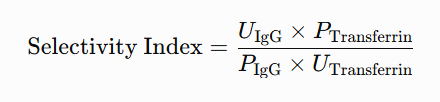
It can also be defined as a ratio:

Or:
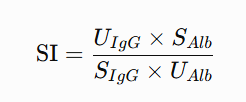
Where:
- Transferrin ≈ 80 kDa
- Albumin ≈ 69 kDa
Interpretation
| Value | Interpretation |
|---|---|
| PSI < 0.1 | Highly selective proteinuria Highly selective |
| PSI = 0.11–0.20 | Moderately selective proteinuria Moderately selective |
| PSI ≥ 0.21 | Non-selective proteinuria Nonselective |
The selectivity score has been used to help predict response to corticosteroid therapy and overall prognosis, particularly in glomerular diseases such as: Minimal Change Disease.
Commonly used but non-standardized ratios
Urinary α1-microglobulin / Albumin ratio
- >0.1 → Mixed proteinuria Mixed proteinuria.
- <0.1 → Pure glomerular proteinuria Purely glomerular proteinuria.
Urinary IgG / Albumin ratio
- <0.03 → Selective glomerular proteinuria.
- >0.03 → Non-selective glomerular proteinuria.
The following ratio
(Albumin + IgG + α1-microglobulin) / Total Urinary Protein
- >0.6 → Renal proteinuria.
- <0.6 → Suggests possible Bence Jones proteinuria.
Summarized and reviewed by Mahmoud Al-Hariri.
Key points
- Glomerular, tubular, overflow and postrenal proteinuria; selectivity indices and their limits.