Basics
Dialysate and water quality
Why dialysate composition is individualised and how water quality, conductivity, and electrolytes relate to safety.
How dialysate is prepared
Dialysis solutions are usually prepared from concentrates and contain either bicarbonate or, much less commonly today, acetate as the principal buffer. Acetate-only dialysis has become uncommon worldwide.
Modern haemodialysis machines proportion purified water and concentrate precisely. They also monitor the final ionic concentration indirectly through electrical conductivity and check temperature and other safety parameters before dialysate reaches the dialyser.
Some units prepare dialysate centrally and distribute it to several machines. A central proportioning system provides the same base composition to all connected stations and may therefore limit the ability to individualize a prescription at each machine.
Bicarbonate-containing concentrates are more physiological, correct metabolic acidosis more effectively, and generally produce fewer intradialytic adverse effects than acetate dialysis. Calcium and magnesium must be kept separate from concentrated bicarbonate during storage because insoluble carbonate salts can precipitate. Acid and bicarbonate streams are therefore mixed with water only late in the preparation pathway, immediately before use.
One simplified representation of calcium-carbonate precipitation is:
CaCl2 + NaHCO3 → calcium bicarbonate species + NaCl → CaCO3 + H2O + CO2
Small quantities of acetic or citric acid are commonly included in the acid concentrate that contains calcium and magnesium. When mixed with bicarbonate, the acid controls the final pH, typically near physiological range, keeps salts soluble, and reduces carbonate precipitation.
Lactate-buffered dialysate is used in a small number of home-haemodialysis systems that deliver slower or more frequent treatments. For example, certain NxStage prescriptions use lactate rather than bicarbonate as the principal buffer anion.
Most dialysate in current conventional practice therefore uses bicarbonate as the dominant buffer; lactate is reserved for selected systems and patients.
Some machines use three concentrate streams—for example electrolytes and glucose, sodium chloride, and bicarbonate—to allow more precise control of individual components.
Sodium
Historically, low-sodium dialysate was used in an attempt to reduce hypertension. It often caused muscle cramps, disequilibrium symptoms, and unstable blood pressure, including severe hypotension and occasionally a counter-regulatory rise in blood pressure through activation of the renin–angiotensin and sympathetic systems.
Modern practice commonly uses dialysate sodium closer to the patient’s plasma sodium. A higher concentration can reduce cramps, nausea, vomiting, and intradialytic hypotension in selected situations. However, a positive sodium balance can increase thirst, interdialytic weight gain, and long-term blood pressure. Dialysate sodium must therefore be individualized rather than simply raised.
Sodium profiling or sodium modelling
Sodium profiling means changing dialysate sodium concentration during a single treatment, usually in an attempt to reduce intradialytic hypotension and cramps.
A typical profile begins with a relatively high sodium concentration, which helps preserve plasma osmolality while blood urea falls. This can support movement of fluid from the interstitial space into the circulation. Dialysate sodium is then reduced gradually or in steps toward the end of treatment. Conductivity measurements are used as an operational surrogate for ionic concentration.
The prescribed dialysate sodium must be considered in relation to the patient’s predialysis plasma sodium. A large positive gradient should be avoided unless there is a specific clinical reason and a plan to prevent sodium loading.
Randomized trials have shown that some sodium-profiling strategies can reduce intradialytic cramps or hypotension, but results vary by profile and comparator. Benefits must be weighed against thirst, sodium balance, interdialytic weight gain, and blood pressure; routine use for everyone is not supported.
The principal risk is sodium accumulation if the concentration is not lowered sufficiently later in the session or if the starting concentration is too high. That can increase thirst, fluid gain, and hypertension. The gradient between dialysate sodium and the patient’s predialysis sodium therefore matters throughout the profile.
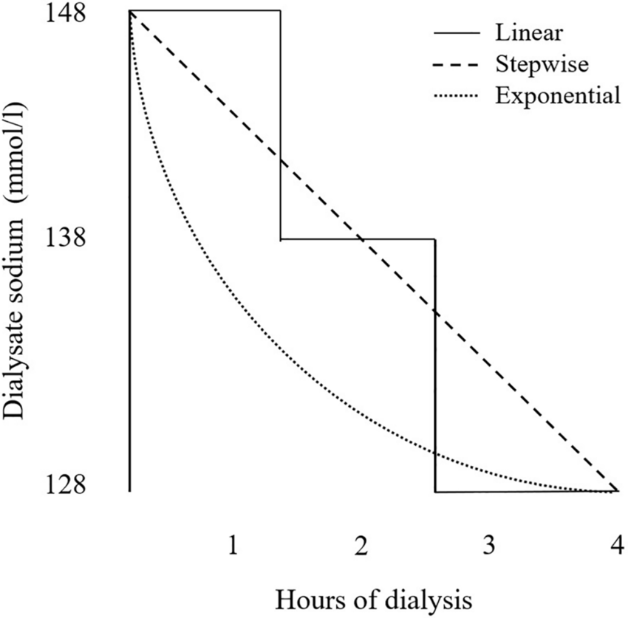
This figure illustrates sodium profiling during haemodialysis. Instead of keeping dialysate sodium constant, the concentration is changed over time.
The vertical axis is dialysate sodium concentration in mmol/L and the horizontal axis is a four-hour dialysis session. The example begins near 148 mmol/L and decreases toward 128 mmol/L. These numbers illustrate the shape of the profiles and are not a universal prescription.
Linear profile
Sodium decreases continuously at a nearly constant rate:
148 → 143 → 138 → 133 → 128 mmol/L
The graph therefore approximates a straight descending line across four hours.
Stepwise profile
Sodium remains at one level for a period and then drops to another:
148 for a period → 138 for a period → 128 for a period
The graph descends in steps.
Exponential profile
The initial fall is rapid:
148 → about 140 → 136 …
The rate of decline then slows until the concentration approaches 128 mmol/L near the end, producing a curved line.
Why begin with higher sodium?
During haemodialysis, removal of urea and other osmoles lowers plasma osmolality. At the same time, UF removes water from the intravascular compartment.
A higher dialysate sodium early in the session may reduce the fall in plasma osmolality, limit water movement into cells, preserve extracellular and intravascular volume, improve vascular refill, and potentially reduce cramps and intradialytic hypotension.
This is the principal physiological rationale for sodium profiling.
If, however, dialysate sodium remains at 148 mmol/L throughout a session while the patient’s plasma sodium is lower, sodium can diffuse into the patient and produce a positive sodium balance.
The later part of a profile therefore lowers dialysate sodium—often toward 138 mmol/L or below—to reduce or reverse the sodium gained early in the session.
The distinction to remember:
UF profiling changes the rate of water removal during the treatment.
Sodium profiling changes the sodium concentration in dialysate.
Glucose and other electrolytes
Potassium
A lower dialysate potassium concentration may occasionally be required when kidney failure is accompanied by severe hyperkalaemia, for example after rhabdomyolysis or a large blood transfusion.
Very low or potassium-free dialysate is rarely needed for routine maintenance dialysis and can cause a rapid gradient, hypokalaemia, and arrhythmia. It requires a specific prescription and close monitoring.
Serum potassium should be checked regularly and, in an acute situation where dialysate potassium is being changed, may need to be measured more than once during or after the treatment.
A small group of patients need a higher dialysate potassium concentration or nutritional review because of persistent hypokalaemia—for example with diarrhoea, vomiting, poor intake, or frequent dialysis.
Calcium
Water softening, deionization, and reverse osmosis have largely eliminated hypercalcaemia caused by hard source water.
Dialysate calcium must nevertheless be prescribed carefully. Sufficient calcium can reduce a large negative calcium balance, while lower dialysate calcium—such as 1.25 mmol/L—may be selected in some patients with hypercalcaemia or severe hyperparathyroidism. Bone-mineral disease, medications, arrhythmia risk, haemodynamic tolerance, and long-term calcium balance all influence the decision.
Glucose
Glucose-containing dialysate can reduce hypoglycaemia and may help preserve plasma osmolality during rapid urea removal. The chosen concentration must take diabetes treatment and nutritional status into account.
Quality
High-quality dialysate is particularly important when high-permeability membranes or high-volume convective therapies are used, because backfiltration or direct online substitution can increase exposure to contaminants.
Acid–base balance: acetate and bicarbonate
Correction of metabolic acidosis is a central function of dialysis.
Hydrogen-ion concentration in blood is extremely low, so acidosis is not corrected by directly dialysing out a large quantity of free hydrogen ions. Instead, base—usually bicarbonate—is supplied in dialysate and moves into blood, replenishing buffer and facilitating removal of acid as carbon dioxide through the lungs.
Early dialysis solutions often contained bicarbonate, but storage and delivery were technically difficult and contamination and instability were concerns. Acetate was introduced as a stable buffer precursor.
Acetate is metabolized mainly in muscle and liver to acetyl coenzyme A and ultimately bicarbonate; the associated acid load is handled through metabolism and respiration.
Acetate dialysis was associated with intradialytic cardiovascular instability, especially when the acetate load exceeded metabolic capacity during more efficient dialysis.
Bicarbonate dialysis was reintroduced widely in the 1980s after improved mixing and delivery systems allowed bicarbonate and calcium-containing acid concentrate to remain separate until use.
Dry bicarbonate cartridges are now common. Powder is dissolved continuously to make a concentrate that the machine proportions with acid concentrate and purified water.
Compared with acetate dialysis, bicarbonate dialysis improves correction of acidosis and generally provides better intradialytic tolerance. The exact bicarbonate prescription should still be individualized to avoid persistent pre-dialysis acidosis or excessive post-dialysis alkalosis.
Water purification
A patient may be exposed across a semipermeable membrane to roughly 300–400 litres of dialysate each week during conventional haemodialysis—about 20,000 litres per year—and to even larger processed-fluid volumes during high-volume convective therapy.
During HD, dissolved contaminants can diffuse across the membrane and, with high-flux membranes, water can move toward the blood during backfiltration. In online haemofiltration or HDF, large quantities of substitution fluid are delivered directly to the bloodstream, making water and dialysate quality critical.
A fatal microcystin poisoning outbreak occurred in Brazil when water contaminated by cyanobacteria was inadequately treated. Patients developed acute neurotoxicity and severe hepatotoxicity.
Other historical outbreaks have included acute fluoride toxicity after a deionizer failure and aluminium toxicity from an unsuitable concrete-lined water-supply pipe. These events show why no single purification step is sufficient.
Treatment train and toxic contaminants
Dialysis-water treatment is a multistage process. A system may include:
Prefilters and microfilters that remove particulate material.
Where required, treatment targeted at specific metals or local source-water contaminants.
Additional fine filtration, sometimes with pore sizes below 1 μm.
Water softeners that exchange calcium, magnesium, iron, and manganese for sodium ions.
Water passes through resin beds where calcium and magnesium are exchanged for sodium. The resin is regenerated periodically with concentrated brine. Pretreated water then passes through activated-carbon tanks.
Activated carbon adsorbs chlorine, chloramine, and many organic contaminants. It is not primarily a fine-particle filter, and paired beds with monitoring are often used to provide safety time.
Reverse osmosis (RO) uses pressure and a selective membrane to reject dissolved ions, microorganisms, endotoxin, and many small organic contaminants.
RO elements are arranged as spiral-wound sheets or other membrane modules. Their selective layers allow water to pass while rejecting most dissolved substances; they do not function as a simple fixed “300-dalton pore” sieve.
A high-pressure pump forces pretreated water across the membrane against the osmotic gradient—hence the name reverse osmosis.
The membrane separates purified product water, called permeate, from the concentrated reject stream. Permeate proceeds to the dialysis distribution loop and machines; reject water is discharged or, in some facilities, recovered for appropriate non-clinical uses.
RO membranes may be cellulose-based or synthetic. Cellulose membranes can be damaged biologically, whereas polyamide and other synthetic membranes are particularly vulnerable to oxidants such as free chlorine and chloramine. Pretreatment must therefore match the membrane.
RO performance is monitored using conductivity of feed and permeate water, pressures, flows, and chemical and microbiological testing. Percent rejection is calculated as:
Rejection (%) = [1 − (permeate conductivity / feed-water conductivity)] × 100
A drop in rejection requires investigation. The acceptable threshold depends on the membrane, system validation, baseline performance, and governing standard; one generic 85% rule should not replace local technical specifications.
Deionization (DI) removes inorganic ions by ion exchange. Mixed-bed systems contain hydrogen-form cation resin and hydroxide-form anion resin. Dissolved cations such as sodium, calcium, and magnesium are exchanged for H+; anions such as chloride, fluoride, and nitrate are exchanged for OH−. H+ and OH− form water. DI is commonly used as a polishing or backup process and requires resistivity monitoring because exhausted resin can release contaminants.
Ultraviolet treatment and ultrafilters may be added to control microorganisms, endotoxin, and biofilm. Nanofiltration is used in selected designs.
Product-water resistivity and conductivity limits are defined by the applicable technical standard and validated system. The older statement that DI effluent must simply exceed 1 MΩ·cm is not a complete safety specification.
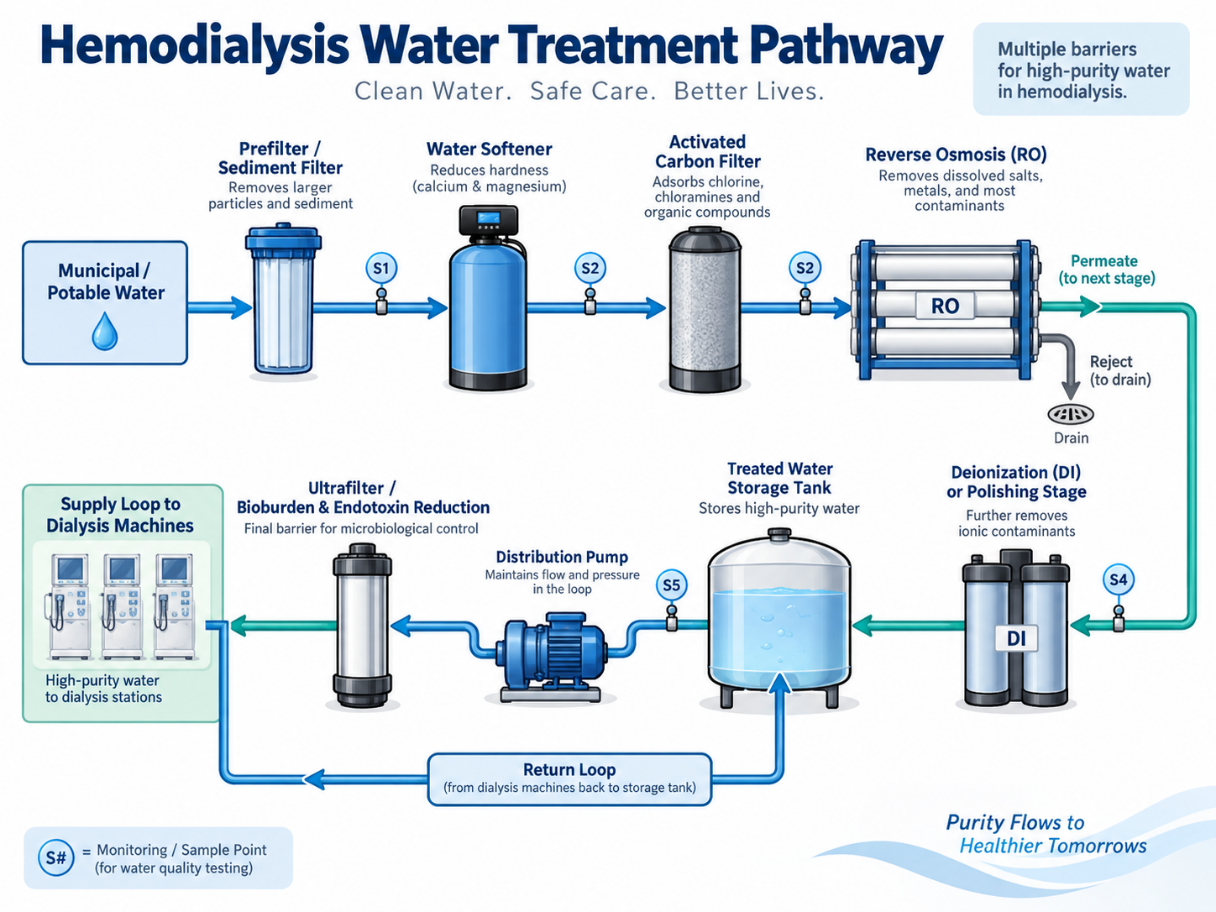
Many major dialysis disasters affecting groups of patients resulted from inadequately treated water transferring contaminants toward the blood. Effective treatment, continuous operational monitoring, and scheduled chemical and microbiological testing are essential. Increasing use of high-flux membranes and online convective therapy raises the importance of water purity. Purity must also be maintained during storage and distribution, and system design and disinfection must prevent biofilm in tanks and pipework.
Online high-volume haemofiltration and HDF require ultrapure dialysis fluid and sterile non-pyrogenic substitution fluid. These are produced through validated additional ultrafiltration within the machine and a water-distribution system that already meets the required chemical and microbiological standard.
Older regional documents used varying limits, for example less than 100 CFU/mL and endotoxin below 0.25 IU/mL in some European conventional-fluid standards, with different historical US thresholds. Current practice should follow the applicable ISO, national, manufacturer, and facility specifications rather than mixing limits from different standards.
Ultrapure dialysis fluid is commonly defined by action levels below 0.1 CFU/mL and endotoxin below 0.03 IU/mL. Studies associate ultrapure fluid with lower inflammatory markers and improved erythropoiesis-stimulating-agent responsiveness, although not every clinical outcome is established with the same certainty.
European professional guidance supports ultrapure dialysis fluid for contemporary haemodialysis, particularly high-flux and online convective therapies. Water treatment and monitoring remain responsibilities of trained dialysis services; patients should never alter concentrates or machine connections.
Key points
- Bicarbonate is commonly used to help correct metabolic acidosis.
- Potassium, sodium, calcium, and glucose concentrations are prescribed for the clinical situation.
- Conductivity and temperature are important operational checks, not a complete water-quality programme.
- Dialysis systems require cleaning, disinfection, and microbiological and chemical monitoring.