Basics
Clearance in dialysis
What clearance means, how blood flow, dialysate flow, and membrane properties affect it, and how Kt/V and URR fit in.
The key idea
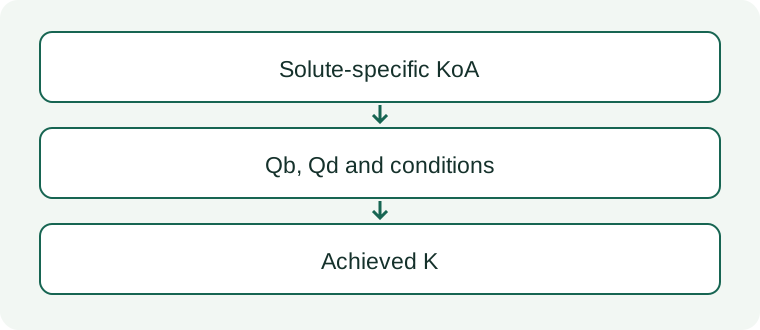
KoA is the mass-transfer coefficient multiplied by membrane area for a specified solute, often urea. It describes solute-transfer capacity under particular conditions, not fluid removal or actual clearance by itself. Delivered clearance also depends on blood flow Qb, dialysate flow Qd and measurement conditions. Leypoldt et al. · HEMO laboratory study · 1997.
| Term | What it describes | Unit or assessment |
|---|---|---|
| KoA | Transfer capacity for a specified solute | mL/min |
| K | Achieved clearance of a specified solute | mL/min |
| KUF | Dialyser water permeability | mL/h/mmHg |
| Kt/V | Urea dose relative to distribution volume | Dimensionless ratio |
Teaching example: K = 200 mL/min, t = 240 minutes and V = 40000 mL give K × t / V = 1.2. This simple calculation assumes constant clearance; it is not a measured spKt/V result or a verdict on a patient’s treatment adequacy.
Do not equate KoA with actual clearance. The laboratory HEMO study found that calculated urea KoA changed with dialysate flow. Manufacturer values should be compared only with the solute and test conditions identified. UK Renal Association · Haemodialysis · July 2019.
Summary
Clearance is a measure of the ability of a dialyser or treatment to lower the concentration of a particular solute in blood per unit time. It does not mean that a physical volume of blood is removed from the body. It represents a hypothetical volume that would be completely cleared of that solute. Clearance is influenced by blood flow Qb, dialysate flow Qd, membrane properties, treatment time, molecular size, protein binding, and distribution between body compartments. [5,6,10,13]
This article distinguishes dialyser clearance from dialysis adequacy, then relates clearance to diffusion, convection, filtration, and ultrafiltration. It also explains the limitations of URR and Kt/V and why one laboratory number cannot by itself judge the whole treatment. [2,3,12]
Keywords: clearance; solute; haemodialysis; diffusion; convection; filtration; ultrafiltration; URR; and Kt/V.
What does clearance mean?
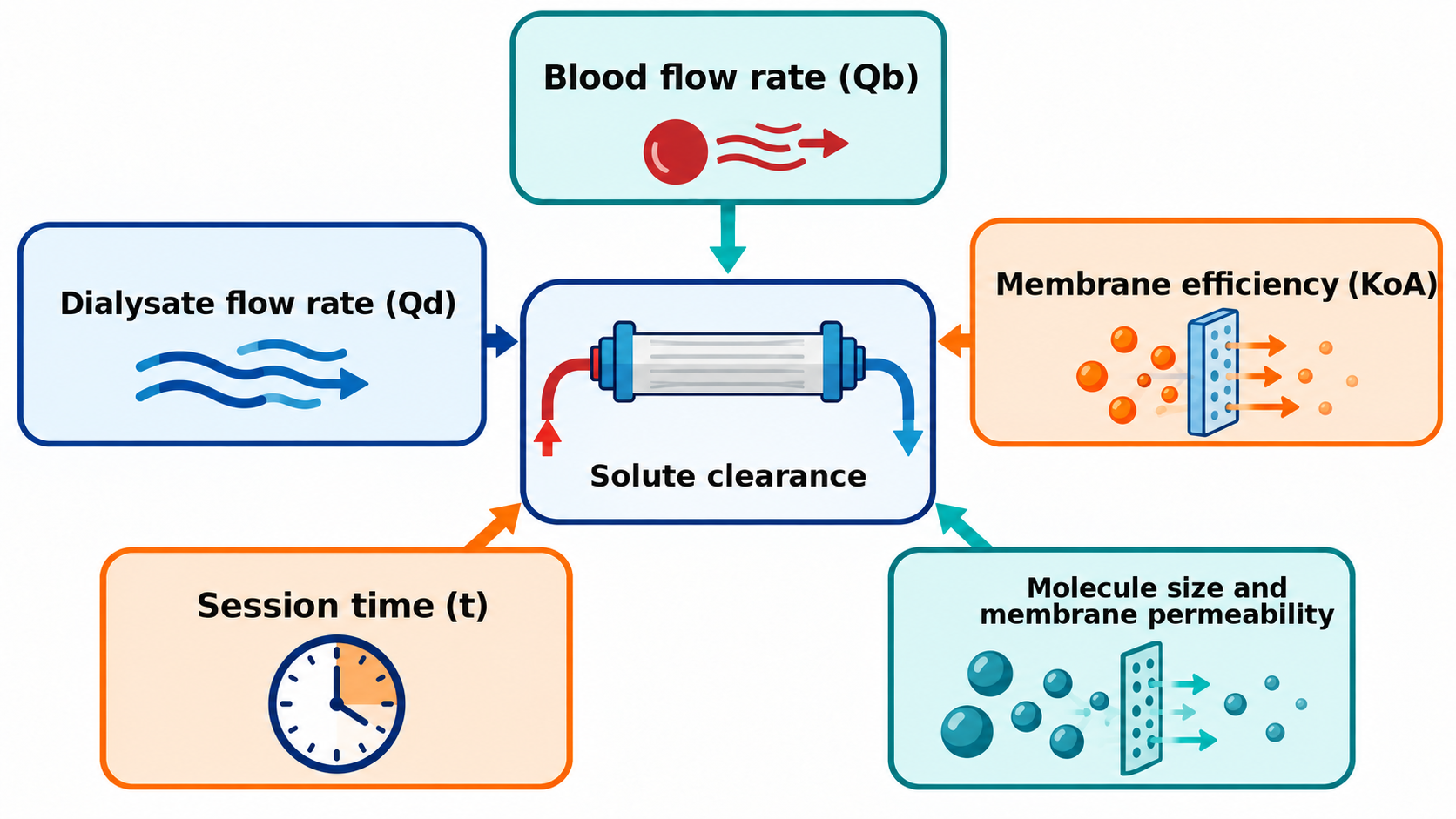
Figure 1. Principal factors that determine solute clearance during haemodialysis.
Clearance is the hypothetical volume of blood or plasma from which a specified solute is completely removed per minute. It is therefore a performance measure, not a description of a separate physical volume leaving the circulation. Clearance may be 300 mL/min even though most blood remains within the circuit and returns to the patient. [5,6]
K ≈ solute removal rate ÷ concentration in incoming blood
This is a teaching approximation. The sample location, flow, timing, and measurement conditions must be specified when actual clearance is calculated.
It is important to distinguish dialyser clearance from whole-body clearance, which includes residual kidney function and redistribution from tissues, and from convective clearance caused by filtration. Improving urea clearance alone may not improve outcomes: post-dialysis rebound, multicompartment distribution, protein binding, and the toxicity of the individual molecule can all limit clinical benefit. [6,13]
Factors that determine clearance
Blood flow Qb: increasing Qb usually raises the clearance of small molecules, but the incremental gain falls as the dialyser approaches its practical transfer limit. Vascular access, circuit pressure, and haemodynamic stability define the safe range; no single value is suitable for everyone.
Under some conditions, doubling Qb can increase urea clearance by roughly 20–50%, with a smaller effect on middle or larger molecules. The result depends on the dialyser, Qd, and measurement method and is not a fixed prescription target. [5,10]
Dialysate flow Qd: countercurrent flow maintains the concentration gradient. Once Qd is already high, further gains are usually modest. In a HEMO Study analysis, increasing Qd from 500 to 800 mL/min raised the measured urea mass-transfer area coefficient by about 14%, with variation between dialysers. [11]
Membrane properties: KoA describes the nominal transfer capacity for a specified solute and depends on the dialyser, solute, and test conditions. KUF describes water permeability during ultrafiltration. Surface area, thickness, pore structure and density, concentration polarization, membrane fouling, and albumin loss all influence performance. [4,5]
Molecular size and protein binding: larger molecules diffuse more slowly and therefore tend to have lower diffusive clearance. Raising blood flow has less effect on large-molecule removal than on small-molecule removal.
Small unbound molecules diffuse most readily. Middle molecules depend more strongly on membrane permeability and convection. Albumin binding reduces the free fraction available for transport, so molecular mass alone cannot predict clearance. [4–6,13]
Treatment time: session duration is one of the most important determinants of the total solute dose removed. More time increases total exposure to clearance and permits transfer from the interstitial compartment into plasma. High-flux membranes and high blood flow may preserve small-solute clearance during a shorter session, but they do not guarantee long-term volume control or removal of larger molecules. [1,5,6]
Haematocrit and intracellular solute movement: at the same Qb, a higher haematocrit reduces the plasma-water flow available for filtration. Urea crosses the red-cell membrane relatively quickly, so haematocrit has a smaller effect on urea clearance than on some other substances. [10]
Clearance and dialysis adequacy
URR, the urea reduction ratio, compares blood urea before and after a session. Kt/V relates urea clearance K, treatment time t, and urea distribution volume V. Sampling timing and technique must be standardized, and post-dialysis rebound must be considered. [2,3,12]
URR = 1 − (Ureapost / Ureapre)
URR can be affected by haemodilution or haemoconcentration, ongoing urea generation, changes in body water, and residual kidney function.
Kt/V = (K × t) / V
Kt/V is used within a validated kinetic model and together with patient information; it should not be interpreted as an isolated number.
A balanced clinical interpretation: neither URR nor Kt/V is sufficient alone. Delivered dose is reviewed together with volume and blood-pressure control, potassium, acidosis, symptoms, nutrition, vascular-access performance, and residual kidney function. [2,3,12]
The relationship between diffusion, convection, and filtration
In conventional haemodialysis, diffusion removes most small molecules while ultrafiltration moves water because of a pressure difference. When that water carries solutes across the membrane, convection occurs. Haemodiafiltration combines diffusion and convection with substitution fluid; total convective volume is not the same as net fluid removal from the patient. [3–6]
Diffusion predominates in continuous venovenous haemodialysis (CVVHD), convection in continuous venovenous haemofiltration (CVVH), and both mechanisms in continuous venovenous haemodiafiltration (CVVHDF). These names describe the predominant mechanism, not absolute physical boundaries; the prescription depends on the acute condition, flow rates, filtration volume, and substitution fluid. [5,6]
Internal filtration followed by backfiltration can occur within a dialyser, so total convection does not always equal net fluid removed from the patient.
Choosing a membrane or HDF prescription requires balancing middle-molecule removal, the risk of albumin loss, water and substitution-fluid quality, and clinical-outcome evidence. One laboratory measurement is not enough.
Conclusion
Clearance is a quantitative language for describing how well a treatment removes a specified solute; it is not a substitute for assessing the patient. Qb, Qd, KoA, KUF, time, membrane permeability, molecular size, and protein binding determine potential removal, while safety, tolerance, and residual function determine what can actually be delivered.
The best interpretation of dialysis adequacy connects the transport mechanism and delivered dose with URR or Kt/V, volume and electrolyte control, and symptoms. This keeps the numbers in clinical context instead of turning them into unsuitable universal targets.
References
[1] KDIGO conference report — Flythe JE, et al. Blood pressure and volume management in dialysis. Kidney International. 2020;97:861–876. DOI: 10.1016/j.kint.2020.01.046. Official text
[2] KDOQI/NKF guideline — National Kidney Foundation. KDOQI Clinical Practice Guideline for Hemodialysis Adequacy: 2015 Update. American Journal of Kidney Diseases. 2015;66:884–930. DOI: 10.1053/j.ajkd.2015.07.015. PubMed
[3] Professional guideline — UK Kidney Association. Clinical Practice Guideline: Haemodialysis. 2019. Official PDF
[4] Membrane review — Ronco C, Clark WR. Haemodialysis membranes. Nature Reviews Nephrology. 2018;14:394–410. DOI: 10.1038/s41581-018-0002-x. DOI
[5] CJASN review — Mohajerani F, Clark WR, Ronco C, Narsimhan V. Mass Transport in High-Flux Hemodialysis. Clinical Journal of the American Society of Nephrology. 2022;17:749–756. DOI: 10.2215/CJN.09410721. PubMed
[6] Clearance review — Lee S, Sirich TL, Meyer TW. Improving Solute Clearances by Hemodialysis. Blood Purification. 2022;51(Suppl 1):20–31. DOI: 10.1159/000524512. PubMed
[10] Review of clearance factors — Huang Z, Clark WR, Gao D. Factors influencing low-molecular-weight solute clearance during hemodialysis. Hemodialysis International. 2005;9:332–337. DOI: 10.1111/j.1542-4758.2005.01149.x. PubMed
[11] HEMO Study — HEMO Study Group. Hemodialyzer mass transfer-area coefficients for urea increase at high dialysate flow rates. Kidney International. 1997;51:2013–2017. DOI: 10.1038/ki.1997.274. PubMed
[12] UK Kidney Association guideline — Clinical Practice Guideline: Haemodialysis. Module 2, 4th edition, 2007 (historical guideline). Official PDF
[13] Review of non-urea clearance — Lee S, Sirich TL, Meyer TW. Improving Clearance for Renal Replacement Therapy. Kidney360. 2021;2:1188–1195. DOI: 10.34067/KID.0002922021. Full text
The figure was created specifically for this educational article. It is schematic and does not represent the engineering dimensions or operational components of a dialysis system.
Key points
- Clearance is a technical measure of how much plasma is cleared of a substance per unit of time.
- Blood flow, dialysate flow, membrane properties, and molecule size all matter.
- Kt/V and URR are useful quality measures but do not capture every aspect of dialysis.
- Symptoms, volume, nutrition, and residual kidney function remain part of the assessment.
Frequently asked questions
What does KoA mean in dialysis?
It is the product of a mass-transfer coefficient and membrane area for a specified solute. It helps describe transfer efficiency but does not determine delivered dialysis dose by itself.
What is the difference between KoA and KUF?
KoA concerns solute transfer. KUF concerns water permeability relative to a pressure difference. Their units and meanings differ.
Does a higher KoA guarantee better dialysis?
It may improve potential transfer of some solutes, but actual clearance depends on flows, treatment time and vascular access. Volume, symptoms, electrolytes and nutrition also matter.
Is KoA the same for every solute?
No. It is specific to a solute and measurement conditions. Urea KoA cannot be directly applied to a protein-bound or larger molecule.
Sources for this explanation
- Leypoldt et al. · HEMO laboratory study · 1997
- Mohajerani et al. · CJASN 2022 · mass transport review
- NKF KDOQI · Hemodialysis Adequacy · 2015 update
- UK Renal Association · Haemodialysis · July 2019
Content and evidence checked: . The check covered UF, KoA or dry-weight interpretation, examples and evidence limits in this article. It is not independent clinical certification or a review of every article on this site.
Share the article link or reuse this original diagram with attribution and a link to the article. Source publications and their figures retain their own rights. Download the educational SVG