Prescription and treatment
High-efficiency, high-flux dialysis, and HDF
The difference between urea removal, membrane permeability, and haemodiafiltration.
High-efficiency haemodialysis
High-efficiency dialysis traditionally refers to a high urea clearance—often greater than 210 mL/min—and a high dialyser urea mass-transfer area coefficient (KoA), often greater than 600 mL/min. KoA combines the membrane’s mass-transfer properties with its effective surface area.
A high-efficiency dialyser may have a low or high ultrafiltration coefficient (KUF), and its membrane may be cellulose-based or synthetic. “Efficiency” mainly describes small-solute transfer under specified operating conditions; it is not synonymous with high-flux.
The manufacturer reports KoA from standardized laboratory testing, often performed in aqueous solutions. In-vivo performance with blood is usually lower because plasma proteins, blood cells, boundary layers, and flow distribution add resistance; the laboratory value may overestimate effective clinical KoA by roughly 20%, although the difference varies.
At low blood-flow rates below about 200 mL/min, urea clearance becomes limited mainly by blood delivery, so high- and lower-efficiency dialysers can perform similarly. The interaction between KoA, blood flow (Qb), and dialysate flow (Qd) is nonlinear: increasing one variable gives progressively smaller gains when another part of the system is limiting.
High-efficiency haemodialysis generally uses a dialyser with a relatively large effective surface area and high KoA, together with adequate blood and dialysate flows and a bicarbonate-based dialysate.
It also requires a vascular access that can deliver the prescribed blood flow reliably. A standard percutaneous catheter may not provide the same stable flow as a well-functioning fistula or graft. Increasing dialysate flow beyond about 500 mL/min produces only a modest additional small-solute clearance and is most useful when blood flow is already adequate.
High-flux haemodialysis
High-flux refers primarily to greater water permeability and enhanced passage of selected middle molecules through the dialysis membrane. Historical definitions have included a beta-2-microglobulin clearance above 20 mL/min. Because these membranes are highly water-permeable, precise volumetric UF control is essential. They also require appropriately treated, microbiologically safe bicarbonate dialysate; ultrapure dialysate is especially important for online convective therapies.
Short-term and mechanistic studies have reported better beta-2-microglobulin removal and lower inflammatory exposure with biocompatible high-flux membranes. Possible effects on residual kidney function, albumin, nutrition, lipids, glucose, and dialysis-related amyloidosis have been explored, but these outcomes are influenced by many aspects of treatment and should not be attributed to membrane flux alone.
The large randomized HEMO study did not demonstrate an overall reduction in death or major morbidity from assigning a higher dialysis dose or high-flux membranes, although a prespecified subgroup with longer dialysis vintage appeared to have lower cardiac mortality. The MPO trial likewise found no overall survival advantage, but suggested possible benefit in patients with low serum albumin and in people with diabetes. Meta-analyses have reported lower cardiovascular mortality and possible all-cause mortality benefit, but certainty and applicability vary. Modern decisions therefore consider membrane performance, patient characteristics, water quality, and the total prescription—not the word “high-flux” alone.
Haemofiltration and haemodiafiltration
Haemofiltration removes solutes predominantly by convection: a pressure gradient drives plasma water across a permeable membrane and eligible solutes are carried with that water.
Large volumes are filtered, so most of the volume must be replaced—historically more than 40 litres per treatment in some prescriptions. The substitution fluid must be sterile and ultrapure, with extremely low microbial and endotoxin contamination.
Haemodiafiltration (HDF) combines haemodialysis and haemofiltration. It uses both diffusion and convection with a high-flux membrane and a convective volume that is much larger than the patient’s net fluid removal.
Effective HDF requires a highly permeable membrane, adequate blood flow, reliable vascular access, suitable treatment time, ultrapure water, and accurate control of substitution and net fluid balance.
Historical haemofiltration prescriptions have used total UF volumes in the range of roughly 60–150 litres per week; HDF convective volumes have often ranged from approximately 9 to 50 litres per session, depending on technique and patient size. Modern high-dose post-dilution online HDF commonly targets a high convection volume that the patient and access can safely achieve.
Substitution fluid can be infused before the dialyser (pre-dilution), after it (post-dilution), or in some systems at an intermediate point (mid-dilution).
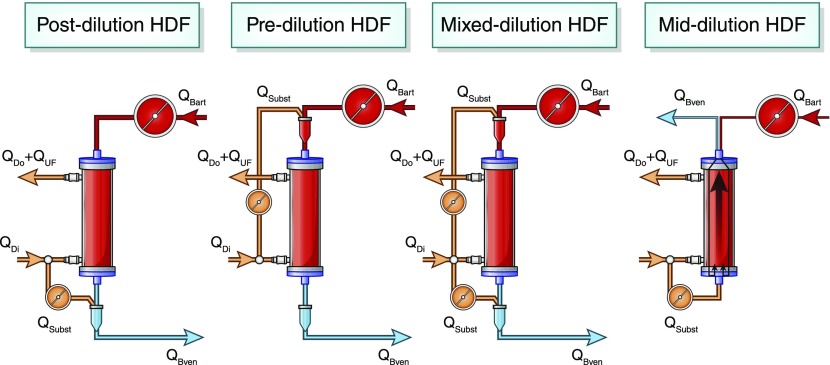
Pre-dilution reduces the concentration of solutes entering the membrane and therefore lowers clearance per litre of convection; a larger substitution volume is needed to obtain an equivalent effect.
Post-dilution provides more efficient clearance per litre, but excessive filtration can concentrate the blood inside the dialyser, promote protein deposition, raise transmembrane pressure, and increase clotting risk.
Online substitution fluid is produced from the dialysate pathway, so the machine and water system must be designed and validated for online HDF. Depending on the machine and prescription, total dialysate-system flow may need to support both dialysate and substitution requirements. Flow settings are selected by trained staff rather than copied from a generic range.
Key points
- High-efficiency refers to greater small-solute removal under particular operating conditions.
- High-flux refers to membrane water permeability and passage of some larger solutes.
- Online HDF adds convection and requires suitable ultrapure water and monitoring systems.
- The CONVINCE trial applies to selected patients and treatment conditions; it does not make HDF suitable for everyone.